
Excerpt from U.S. Coast Guard Proceedings of the Marine Safety & Security Council magazine by Mr. Luke Woodling, Digital Content Manager, Water Sports, Bonnier Corporation.
Visit Program. The Coast Guard’s Recreational Boat Manufacturer Factory Visit program affords water ski and wakeboard boat manufacturers the peace of mind that boats coming off their assembly lines are as safe as possible, which is particularly reassuring in a market that is so family-focused.
What do the Manufacturers Think About the Program? Dan Gasper, the director of research and development at Malibu Boats, said “It’s comforting to know that you’re building by those specifications, because you know the boat will be safe. Safety is what they’re all about.”
“It’s not as if they print these regulations and run,” added Bill Snook, chief engineer at Nautique Boats. “They come in and look over our shoulder and see what we’re building. There is peace of mind in that.”
Results. The Coast Guard’s regulations and factory visit program do more than just instill confidence—they also enable water ski and wakeboard boat manufacturers to focus on innovation.
Resources that would have to be dedicated to developing and carrying out safety protocols are instead freed up to design everything from state-of-the-art dashboards to more functional towers and ballast systems.
“Without the Coast Guard’s support, we’d have to put more of our resources into solving problems and making sure that we’re building a safe product,” Snook said. “Now all we have to do is follow the specifications—buy this part and assemble it in this way. We don’t have to invent any of that. All we have to do is follow what they specify, and we know we have a much better and safer product.”
Full article is available at http://www.uscg.mil/proceedings/fall2010.
Subscribe online at http://www.uscg.mil/proceedings/subscribe.asp.

A discussion forum on Marine Safety, Recreational Boating Safety, and waterways managment as we work together to protect maritime commerce and mobility, the marine environment, and safety of life at sea.
Showing posts with label Recreational Boating Safety. Show all posts
Showing posts with label Recreational Boating Safety. Show all posts
Wednesday, August 31, 2011
Thursday, August 18, 2011
U.S. Army Corps of Engineers Life Jacket Policy Test: More wear? More lives saved.

Excerpt from U.S. Coast Guard Proceedings of the Marine Safety & Security Council magazine by Ms. Lynda Nutt, U.S. Army Corps of Engineers, Manager, National Operations Center for Water Safety
Despite the national reductions in recreational boating-related casualties following the Federal Boating Safety Act of 1971, U.S. Army Corps of Engineers (USACE) recreation managers struggled to minimize serious injuries and fatalities occurring on their waters throughout the 1970s and 1980s.
By 1985, the corps was using aggressive water safety educational campaigns and key visitor assistance initiatives led by park rangers in local communities, parks, and on the water to warn the public of open water recreation risks and encourage safer behaviors. While all these efforts had a dramatic effect on reducing the numbers of fatalities, they still averaged 170 each year.
 In 2007, USACE Maj. Gen. Donald T. Riley tasked personnel to conduct a policy test to measure the effect of adopting a mandatory life jacket policy. In 2008, USACE moved out with its policy test in the Pittsburgh and Vicksburg Districts.
Vicksburg Findings Impressive
Vicksburg officials reported that the initial public reaction to the life jacket policy was mixed. However, rangers were able to gain significant compliance without having to issue one citation over the course of the recreational summer.
Pittsburgh Results Disappoint
Since 1990, Pittsburgh District policy mandated that life jackets be worn by all non-swimmers and occupants of vessels under 16 feet. Unfortunately by the end of the “test” recreation season, it had achieved only a 3.7 percent cumulative wear rate on the test lakes in this region, while nearby control lakes in Ohio showed wear rates of more than seven percent.
Clearly, the policy had become stale after nearly two decades with no new emphasis on promotion or enforcement. The policy was also limited in scope, applying only to craft less than 16 feet, while the majority of boats on these test lakes were greater in size. It was also noted that Ohio boating safety officials were engaged to a much greater degree in the National Safe Boating Council’s “Wear It!” campaign to encourage voluntary life jacket wear.

Despite the national reductions in recreational boating-related casualties following the Federal Boating Safety Act of 1971, U.S. Army Corps of Engineers (USACE) recreation managers struggled to minimize serious injuries and fatalities occurring on their waters throughout the 1970s and 1980s.
By 1985, the corps was using aggressive water safety educational campaigns and key visitor assistance initiatives led by park rangers in local communities, parks, and on the water to warn the public of open water recreation risks and encourage safer behaviors. While all these efforts had a dramatic effect on reducing the numbers of fatalities, they still averaged 170 each year.
In 2007, USACE Maj. Gen. Donald T. Riley tasked personnel to conduct a policy test to measure the effect of adopting a mandatory life jacket policy. In 2008, USACE moved out with its policy test in the Pittsburgh and Vicksburg Districts.Vicksburg Findings Impressive
Vicksburg officials reported that the initial public reaction to the life jacket policy was mixed. However, rangers were able to gain significant compliance without having to issue one citation over the course of the recreational summer.
Observation data supported that a cumulative wear rate of nearly 71 percent on the Vicksburg test waters. Comparatively, nearby “control” lakes, where policy wasn’t introduced, were still showing only six percent wear rates.
Pittsburgh Results Disappoint
Since 1990, Pittsburgh District policy mandated that life jackets be worn by all non-swimmers and occupants of vessels under 16 feet. Unfortunately by the end of the “test” recreation season, it had achieved only a 3.7 percent cumulative wear rate on the test lakes in this region, while nearby control lakes in Ohio showed wear rates of more than seven percent.
Clearly, the policy had become stale after nearly two decades with no new emphasis on promotion or enforcement. The policy was also limited in scope, applying only to craft less than 16 feet, while the majority of boats on these test lakes were greater in size. It was also noted that Ohio boating safety officials were engaged to a much greater degree in the National Safe Boating Council’s “Wear It!” campaign to encourage voluntary life jacket wear.
Future Efforts
USACE officials have documented four lives saved on the Mississippi lakes specifically tied to the policies implemented during the first test season.
“These victims stated that they would not have worn a life jacket if it hadn’t been for the policy,” said Michael Ensch, chief of the USACE Operations Division. “In each case, the situations were challenging enough that survival without the life jacket was questionable.”
The USACE will continue the tests in the Pittsburgh and Vicksburg Districts and will evaluate data collection in monitoring wear rates. In addition, impact on staffing/budget requirements and capabilities, and public, stakeholder, and congressional reactions will also be monitored and evaluated. All findings will be forwarded to USACE leadership for action.
Full article is available at http://www.uscg.mil/proceedings/fall2010.
Subscribe online at http://www.uscg.mil/proceedings/subscribe.asp.
“These victims stated that they would not have worn a life jacket if it hadn’t been for the policy,” said Michael Ensch, chief of the USACE Operations Division. “In each case, the situations were challenging enough that survival without the life jacket was questionable.”
The USACE will continue the tests in the Pittsburgh and Vicksburg Districts and will evaluate data collection in monitoring wear rates. In addition, impact on staffing/budget requirements and capabilities, and public, stakeholder, and congressional reactions will also be monitored and evaluated. All findings will be forwarded to USACE leadership for action.
Full article is available at http://www.uscg.mil/proceedings/fall2010.
Subscribe online at http://www.uscg.mil/proceedings/subscribe.asp.

Wednesday, August 17, 2011
Safe Paddle Sports
Excerpt from U.S. Coast Guard Proceedings of the Marine Safety & Security Council magazine by Mr. Jeremy Oyen, Director of Safety Education, Instruction, and Outreach, American Canoe Association
The American Canoe Association offers online resources to paddlers of all abilities and levels, including:
The American Canoe Association offers online resources to paddlers of all abilities and levels, including:
- 11 safety brochures (four translated into Spanish),
- 4 safety pamphlets,
- 4 safety posters,
- 8 safety and stewardship videos.
Additional information and training is available for classroom and on-water education. The goal is to reduce the number of accidents and fatalities by emphasizing the need for education even for those who do not consider themselves “paddlers,” but might use a canoe, kayak, or raft to participate in other outdoor activities.
Full article is available at http://www.uscg.mil/proceedings/fall2010.
Subscribe online at http://www.uscg.mil/proceedings/subscribe.asp.
Tuesday, August 16, 2011
U.S. Coast Guard Recreational Boating Safety Specialists—Part 2
Excerpt from U.S. Coast Guard Proceedings of the Marine Safety & Security Council magazine
Regional Emphasis
USCG First District
In the 1st District, paddlesport safety is a huge concern.
Many fatalities occur on whitewater or in colder coastal waters as paddlers take advantage of the seasonal changes. The RBS specialist works with the Coast Guard Auxiliary, outfitters, retailers, and other paddling organizations coordinating training seminars to enhance safety awareness and risk-based decision making.
USCG Fifth District
USCG Fifth District
The 5th District specialist serves as Executive Secretary of the Virginia Recreational Vessel Subcommittee and manages the Coast Guard Outreach Innovation Center, which contains a variety of boating safety outreach materials and displays for RBS partners.

USCG Seventh District
Due to a year-round boating season and a high population of seasonal residents and tourists, the 7th District specialist travels around the district with a Boating Advisory Trailer Public Awareness Kit. Also known as the “Bat-Pak,” this rolling boating safety classroom provides hands-on recreational boating safety training.
Due to a year-round boating season and a high population of seasonal residents and tourists, the 7th District specialist travels around the district with a Boating Advisory Trailer Public Awareness Kit. Also known as the “Bat-Pak,” this rolling boating safety classroom provides hands-on recreational boating safety training.
USCG Eighth District
The 8th District specialist serves as the district boating under the influence and Boating Safety Strike Team program manager. The strike team supports state marine patrol efforts during annual high-profile marine events such as Cincinnati’s “Tall Stacks” and provides surge capability on waters popular with exuberant boaters, such as the Lake of the Ozarks.
USCG Ninth District
The 9th District’s specialist coordinates joint training for marine patrol officers, collaborates on annual district boarding and BUI guidance, and is a contributing writer for Mid-America Boating, a regional newspaper for Great Lakes boaters.
The 8th District specialist serves as the district boating under the influence and Boating Safety Strike Team program manager. The strike team supports state marine patrol efforts during annual high-profile marine events such as Cincinnati’s “Tall Stacks” and provides surge capability on waters popular with exuberant boaters, such as the Lake of the Ozarks.
USCG Ninth District
The 9th District’s specialist coordinates joint training for marine patrol officers, collaborates on annual district boarding and BUI guidance, and is a contributing writer for Mid-America Boating, a regional newspaper for Great Lakes boaters.

USCG Eleventh District
In the 11th District, the RBS specialist participates in the “Wear It California!” life jacket campaign. Supporting several booths at various marinas in “the Delta,” where the Sacramento and San Joaquin Rivers meet, inflatable life jackets are distributed to anyone who signs a pledge to wear it when on the water.
The RBS specialist also participates in the Tri-State Boating Safety Fair at Lake Havasu, Ariz., assisting officers from Arizona, California, and Nevada with life jacket trade-in.
USCG Thirteenth District
The 13th District’s specialist manages the district recreational boating policy. In addition, he or she is a member of the Washington State Drowning Prevention Coalition, the Washington State Parks Boating Safety Council, and is an advisory member to several boating advocacy groups.
USCG Fourteenth District
The 14th District recreational boating safety specialist oversees the CG-4100 report of boarding forms and coordinates a variety of safe boating events and activities related to the annual National Safe Boating Week observance.
USCG Seventeenth District

This specialist is perhaps the most unique. The 17th District RBS specialist deploys RBS teams to the Arctic to raise boating safety awareness and instill best practices among the regional Native American tribes. In addition, he or she employs boating education and safety teams around the state, oversees the CG-4100 report of boarding forms, and coordinates boarding officer and boarding team member training.
Full article is available at http://www.uscg.mil/proceedings/fall2010.
Full article is available at http://www.uscg.mil/proceedings/fall2010.
Subscribe online at http://www.uscg.mil/proceedings/subscribe.asp.
Visit Part 1 here for more information on U.S. Coast Guard Recreational Boating Safety Specialists.
Thursday, August 11, 2011
U.S. Coast Guard Recreational Boating Safety Specialists—Part 1
Excerpt from U.S. Coast Guard Proceedings of the Marine Safety & Security Council magazine by Mr. Frank Jennings, Jr., Recreational Boating Safety Specialist, Ninth Coast Guard District and Mr. Bruce R. Wright, Recreational Boating Safety Specialist, Seventh Coast Guard District
While the Coast Guard headquarters’ Boating Safety Division functions at a strategic level, recreational boating safety (RBS) specialists are assigned primarily to district prevention division staffs.
Myriad Duties
Recreational boating safety specialists each serve as the principal Coast Guard liaison to individual state boating law administrators and their staffs. This regular contact may involve discussions of unclassified Coast Guard operations within the state; emerging recreational boating issues, boating casualty investigations, or joint operations planning; or local boaters’ complaints.
Recreational boating safety specialists also coordinate and host workshops and professional training programs, serve as the Coast Guard’s “ambassadors” to RBS partners, such as municipal water safety agencies, local safe boating coalitions, the Red Cross, and the U.S. Power Squadrons, and hold active memberships in organizations including the National Safe Boating Council, National Water Safety Congress, and International Association of Marine Investigators.
Jurisdiction
In addition to liaison duties, these specialists are responsible for the district recreational boating safety cooperative agreements the Coast Guard maintains with each state and territory, which delineate the responsibilities shared by the state and Coast Guard on waters of concurrent jurisdiction.
Special Efforts
One overarching safety message continues to be the importance of wearing a life jacket when boating. However, because boating constituencies and activities vary from district to district, the message may require slight modification to reach localized user groups.
Stay tuned for U.S. Coast Guard Recreational Boating Safety Specialists—Part 2.
Full article is available at http://www.uscg.mil/proceedings/fall2010.
Subscribe online at http://www.uscg.mil/proceedings/subscribe.asp.
While the Coast Guard headquarters’ Boating Safety Division functions at a strategic level, recreational boating safety (RBS) specialists are assigned primarily to district prevention division staffs.
Myriad Duties
Recreational boating safety specialists each serve as the principal Coast Guard liaison to individual state boating law administrators and their staffs. This regular contact may involve discussions of unclassified Coast Guard operations within the state; emerging recreational boating issues, boating casualty investigations, or joint operations planning; or local boaters’ complaints.
Recreational boating safety specialists also coordinate and host workshops and professional training programs, serve as the Coast Guard’s “ambassadors” to RBS partners, such as municipal water safety agencies, local safe boating coalitions, the Red Cross, and the U.S. Power Squadrons, and hold active memberships in organizations including the National Safe Boating Council, National Water Safety Congress, and International Association of Marine Investigators.
Jurisdiction
In addition to liaison duties, these specialists are responsible for the district recreational boating safety cooperative agreements the Coast Guard maintains with each state and territory, which delineate the responsibilities shared by the state and Coast Guard on waters of concurrent jurisdiction.
Special Efforts
One overarching safety message continues to be the importance of wearing a life jacket when boating. However, because boating constituencies and activities vary from district to district, the message may require slight modification to reach localized user groups.
Stay tuned for U.S. Coast Guard Recreational Boating Safety Specialists—Part 2.
Full article is available at http://www.uscg.mil/proceedings/fall2010.
Subscribe online at http://www.uscg.mil/proceedings/subscribe.asp.
Tuesday, August 9, 2011
The National Safe Boating Council
Excerpt from U.S. Coast Guard Proceedings of the Marine Safety & Security Council magazine by Mr. Virgil Chambers, Executive Director, National Safe Boating Council
The National Safe Boating Council is a coalition of organizations working together to promote safe boating. Membership consists of more than 330 U.S. and Canadian organizations, with approximately 35 percent composed of for-profit organizations and 65 percent non-profit organizations as well as local boat clubs, foundations, and law enforcement agencies.
Outreach
Each year, in partnership with the National Water Safety Congress, the NSBC produces the International Boating and Water Safety Summit, a venue for training professionals and volunteers within the recreational boating safety community.
Additional NSBC member-requested programs include boating safety instructor training and “Boating Safety Sidekicks” for children.
National Safe Boating Week
Each year since 1952, boating safety organizations and advocates across the country organize to promote safe boating. During this National Safe Boating Week (the week before Memorial Day), organizations address topics including alcohol and boating, boater education, and life jacket wear.
The current nationwide "Wear It!" campaign urges recreational boaters to wear life jackets at all times, as it has been estimated this could reduce drowning by as much as 90 percent. A large component of the campaign is educating people about USCG-approved items.
Close-Quarters Boat Control
The NSBC’s newest training program focuses on maneuvers and techniques for enforcement officers and safety patrol boat handlers to operate power boats, using factors like wind and current to assist in boat placement.
Full article is available at http://www.uscg.mil/proceedings/fall2010.
Subscribe online at http://www.uscg.mil/proceedings/subscribe.asp.
The National Safe Boating Council is a coalition of organizations working together to promote safe boating. Membership consists of more than 330 U.S. and Canadian organizations, with approximately 35 percent composed of for-profit organizations and 65 percent non-profit organizations as well as local boat clubs, foundations, and law enforcement agencies.
Outreach
Each year, in partnership with the National Water Safety Congress, the NSBC produces the International Boating and Water Safety Summit, a venue for training professionals and volunteers within the recreational boating safety community.
Additional NSBC member-requested programs include boating safety instructor training and “Boating Safety Sidekicks” for children.
National Safe Boating Week
Each year since 1952, boating safety organizations and advocates across the country organize to promote safe boating. During this National Safe Boating Week (the week before Memorial Day), organizations address topics including alcohol and boating, boater education, and life jacket wear.
The current nationwide "Wear It!" campaign urges recreational boaters to wear life jackets at all times, as it has been estimated this could reduce drowning by as much as 90 percent. A large component of the campaign is educating people about USCG-approved items.
Close-Quarters Boat Control
The NSBC’s newest training program focuses on maneuvers and techniques for enforcement officers and safety patrol boat handlers to operate power boats, using factors like wind and current to assist in boat placement.
Full article is available at http://www.uscg.mil/proceedings/fall2010.
Subscribe online at http://www.uscg.mil/proceedings/subscribe.asp.
Friday, August 5, 2011
40th Anniversary of the Federal Boat Safety Act of 1971
Next Wednesday, August 10th, is the 40th anniversary of the enactment of the Federal Boat Safety Act. In 1971, there were 5,510,092 numbered (registered) boats and 1,582 boating deaths. In 2010, there were 12,438,926 registered boats and 672 boating deaths. These results are directly tied to the successes of the Federal Boat Safety Act of 1971.

Thursday, July 28, 2011
The U.S. Coast Guard Auxiliary expands its safety-related courses.
Excerpt from U.S. Coast Guard Proceedings of the Marine Safety & Security Council magazineby Ms. Anne R. Lockwood, Director of Education,
U.S. Coast Guard Auxiliary
Comprehensive Courses
The premier USCG Auxiliary public education courses are “Boating Skills and Seamanship” and “Sailing Skills and Seamanship.” These extensive safety courses provide up-to-date information on handling boats in all conditions.
The premier USCG Auxiliary public education courses are “Boating Skills and Seamanship” and “Sailing Skills and Seamanship.” These extensive safety courses provide up-to-date information on handling boats in all conditions.
Kayakers and Canoeists
Reaching out to one of the fastest- growing audiences in North America, the Auxiliary’s newest course is “Paddlesports America.” The target audience is novice kayakers and canoeists. This five-chapter, four-hour course addresses how to be safe on the water and return home safely.
Reaching out to one of the fastest- growing audiences in North America, the Auxiliary’s newest course is “Paddlesports America.” The target audience is novice kayakers and canoeists. This five-chapter, four-hour course addresses how to be safe on the water and return home safely.

What if … ?
“Suddenly in Command” is designed for a person who suddenly becomes the helmsman when the boat operator becomes incapacitated. The course is a two- to four-hour seminar, designed to educate a person who becomes suddenly in charge of returning the boat to shore. The target audience ranges from a child out fishing with Granddad to an adult out for a boat ride.
“Suddenly in Command” is designed for a person who suddenly becomes the helmsman when the boat operator becomes incapacitated. The course is a two- to four-hour seminar, designed to educate a person who becomes suddenly in charge of returning the boat to shore. The target audience ranges from a child out fishing with Granddad to an adult out for a boat ride.
Full article is available at http://www.uscg.mil/proceedings/fall2010.
Subscribe online at http://www.uscg.mil/proceedings/subscribe.asp.
Subscribe online at http://www.uscg.mil/proceedings/subscribe.asp.
Wednesday, July 27, 2011
Recreational Boating Mandatory Education Initiatives
Excerpt from U.S. Coast Guard Proceedings of the Marine Safety & Security Council magazine by Mr. Harry Hogan, U.S. Coast Guard Office of Auxiliary and Boating Safety and Mr. Jeff Ludwig, Regulatory Development Manager, U.S. Coast Guard Boating Safety Division
Executive Secretary, National Boating Safety Advisory Council
To reduce the number of recreational boating accidents, many states have mandated various types of education and licensing for motorized vessel operators. There are five general categories into which the recreational operator boating safety instruction requirements can be grouped.
Under a certain age: requires boat operators under a certain age to complete a boating safety course.
Born after a specified date: requires the boat operator to complete a class if he or she was born on or after a specific date.
Quick phase-in of all operators: several states have mandated boating safety instruction for their entire operator population, or at least up to a specified “grandfathered-in” age. This third group conducted a quick phase-in approach to getting their boaters educated, typically by requiring operators in younger age ranges to take courses first, then incrementally increasing the mandated age range.
Where no requirements exist: several states have no boating safety education requirements.
For personal watercraft operators only: some states have boating safety education requirements for personal watercraft operators only.
Advantages of the Quick Phase-In Policy
In 2006 the Coast Guard sponsored a study of operators involved in fatal accidents, finding that for the period of 1995 through 2005, the median age was 40, which means that in approximately 50 percent of the fatal motorized vessel accidents, the operator was over 40.
In 2006 the Coast Guard sponsored a study of operators involved in fatal accidents, finding that for the period of 1995 through 2005, the median age was 40, which means that in approximately 50 percent of the fatal motorized vessel accidents, the operator was over 40.
Therefore, the states with youth-based or “under a certain age” requirements are not reaching the majority of boaters involved in fatal accidents, and the states with a “born after” cut-off policy will typically have a long wait before they reach boaters who are 40.

Examining Trends
Currently, Alabama and Connecticut are the only states that have required all motorized vessel operators to obtain boating safety instruction for enough years that before/after comparisons are reasonable.
PICTURED: Mandatory boat operator safety instruction is often conducted as classroom-style sessions.
The study used the combined fatal accident rate (or FAR) of Alabama and Connecticut to show that future quick phase-in policy states should expect an approximately 25 percent decline in fatal accident rate. Using data from 2006 through 2008, Alabama and Connecticut have an average combined FAR of 3.9 fatal accidents per 100,000 registered motorized vessels.
This is 32 percent lower than the average fatal accident rate during what was considered their combined phase-in period from 1995 to 1999.
Further examination reveals that Alabama is driving the low fatal accident rate for this recent three-year period. Alabama has more than twice as many registered motorized vessels, at an average of 270,034, compared to Connecticut’s 108,875. Alabama’s average FAR was 3.8 fatal accidents per 100,000 registered motorized vessels during this three-year period, which is 45 percent lower than the average during phase-in.
Conversely, Connecticut had a FAR of 4.0, which was 66 percent higher than the average during phase-in. One possible explanation for Connecticut’s higher fatal accident rate in the past three years is its low number of total fatal accidents (averaging 4.3 per year for the past three years), which can result in major percentage changes with just a few accidents.
Confirming TrendsThe major assumption is that the quick phase-in policy is the primary factor in fatal accident rate reduction. Another assumption is that other states will follow trends that are similar to Alabama and Connecticut’s (or at least Alabama’s).
Further examination reveals that Alabama is driving the low fatal accident rate for this recent three-year period. Alabama has more than twice as many registered motorized vessels, at an average of 270,034, compared to Connecticut’s 108,875. Alabama’s average FAR was 3.8 fatal accidents per 100,000 registered motorized vessels during this three-year period, which is 45 percent lower than the average during phase-in.
Conversely, Connecticut had a FAR of 4.0, which was 66 percent higher than the average during phase-in. One possible explanation for Connecticut’s higher fatal accident rate in the past three years is its low number of total fatal accidents (averaging 4.3 per year for the past three years), which can result in major percentage changes with just a few accidents.
Confirming TrendsThe major assumption is that the quick phase-in policy is the primary factor in fatal accident rate reduction. Another assumption is that other states will follow trends that are similar to Alabama and Connecticut’s (or at least Alabama’s).
Full article is available athttp://www.uscg.mil/proceedings/fall2010.
Subscribe online athttp://www.uscg.mil/proceedings/subscribe.asp.

PICTURED: The test crash demonstrates the severity of damage that can occur.
Wednesday, July 20, 2011
Operation Dry Water
Excerpt from U.S. Coast Guard Proceedings of the Marine Safety & Security Council magazine by Mr. Mike Baron, Recreational Boating Safety Specialist, U.S. Coast Guard Boating Safety Division, Program Operations Branch

For more information visit http://www.operationdrywater.org/
From June 26-29, 2009, “Operation Dry Water,” served to illustrate that BUI (boating under the influence) is a nationwide problem, and that law enforcement is taking it seriously. Coordinated activities occurred in 52 of 56 U.S. states and territories where federal, state, and local law enforcement agencies worked side by side to make the weekend a success.
One Sector’s Statistics
U.S. Coast Guard Sector Hampton Roads in Portsmouth, Va., has an area of responsibility that covers a large portion of the Chesapeake Bay and its adjacent coastal and state waters. Sector Hampton Roads’ Operation Dry Water stats:
U.S. Coast Guard Sector Hampton Roads in Portsmouth, Va., has an area of responsibility that covers a large portion of the Chesapeake Bay and its adjacent coastal and state waters. Sector Hampton Roads’ Operation Dry Water stats:
- 1,079 dedicated hours
- 372 U.S. Coast Guard boardings
- 1,635 boardings by other government agencies
- 7 arrests for BUI
- 5 arrests for other crimes discovered during the boarding process
- 13 recreational vessel voyages terminated
Future Plans
Plans are in place to make Operation Dry Water an annual event. It’s imperative, however, that boaters are aware that law enforcement professionals are serious about BUI, and that the weekend of Operation Dry Water isn’t the only time the laws will be enforced.For more information:Full article is available at http://www.uscg.mil/proceedings/fall2010
Subscribe online at http://www.uscg.mil/proceedings/subscribe.asp.
A boater’s blood alcohol content (BAC) registers above the .08 legal limit. Photo courtesy of the Arizona Game and Fish Department.
For more information visit http://www.operationdrywater.org/
Tuesday, July 12, 2011
The National Association of State Boating Law Administrators
Excerpt from U.S. Coast Guard Proceedings of the Marine Safety & Security Council magazine by Col. Terry West, Boating Law Administrator and Assistant Director, Georgia Department of Natural Resources
President, National Association of State Boating Law Administrators
The National Association of State Boating Law Administrators (NASBLA) is a non-profit organization that works to develop public policy for recreational boating safety. The association addresses its mission by:
President, National Association of State Boating Law Administrators
The National Association of State Boating Law Administrators (NASBLA) is a non-profit organization that works to develop public policy for recreational boating safety. The association addresses its mission by:
- fostering partnerships among the states, the Coast Guard, and others;
- crafting model boating laws;
- maintaining national education and training standards;
- providing members with critical knowledge and skills;
- assisting in homeland security challenges on our waterways;
- advocating the needs of the state boating programs before Congress and federal agencies.
Partnering to Protect Boaters
One major task is to ensure that boating safety funds from the Sport Fish Restoration and Boating Trust Fund are allocated for state boating safety programs.
Safety Standards and Reference Materials
In another effort to promote uniformity and reciprocity among the states, the National Association of State Boating Law Administrators developed boating safety education standards in the 1970s. Working with Penn State University and boating safety partners such as the United States Power Squadrons, U.S. Coast Guard Auxiliary, and National Safe Boating Council, NASBLA adopted the National Boating Education Standards in 1999.
Law Enforcement, Investigation, and Detection Efforts
Through cooperation with the U.S. Coast Guard and the National Transportation Safety Board, NASBLA conducts courses that teach officers how to conduct consistent, thorough accident investigations.
In 2004, National Association of State Boating Law Administrators began teaching boating under the influence (BUI) detection and enforcement courses that cover planning for BUI enforcement, arrest decisions, BUI suspect processing procedures, essential elements of the arrest report, note taking and report writing, pre-trial conferences and presentation of evidence, and proper administration of sobriety tests.
For more information:
Website: http://nasbla.org/.
Full article is available at http://www.uscg.mil/proceedings/fall2010.
Subscribe online at http://www.uscg.mil/proceedings/subscribe.asp.
Wednesday, July 6, 2011
United States Power Squadrons
Excerpt from U.S. Coast Guard Proceedings of the Marine Safety & Security Council magazine by Vice Commander Robert Sweet, Senior Navigator, National Educational Officer, United States Power Squadrons
With grant funding provided by the Sport Fish Restoration and Boating Safety Trust Fund, and administered by the U.S. Coast Guard, United States Power Squadrons (USPS) is refining a program that can be delivered across the country to a large number of boaters.
Training the Trainers
The principal challenge is training enough boaters to make a difference. USPS has established a system for training advanced certifiers who can instruct the program. More than 400 individuals have been certified by USPS trainers to administer this program in the past year, and this training continues. The initial program is being tailored to address key risk factors and areas of concern expressed by boaters.
Audience Participation The program includes extensive classroom training to help boaters understand how boats behave in the water and why and how they respond to controls. Animations, videos, and graphics-based text help to explain boat actions and maneuvers.
By the time participants getto the helm on the water, they know what to expect, so their helm time is much more efficient and helps them to quickly ingrain proper techniques.
With grant funding provided by the Sport Fish Restoration and Boating Safety Trust Fund, and administered by the U.S. Coast Guard, United States Power Squadrons (USPS) is refining a program that can be delivered across the country to a large number of boaters.
Training the Trainers
The principal challenge is training enough boaters to make a difference. USPS has established a system for training advanced certifiers who can instruct the program. More than 400 individuals have been certified by USPS trainers to administer this program in the past year, and this training continues. The initial program is being tailored to address key risk factors and areas of concern expressed by boaters.
Audience Participation
The program includes extensive classroom training to help boaters understand how boats behave in the water and why and how they respond to controls. Animations, videos, and graphics-based text help to explain boat actions and maneuvers.By the time participants getto the helm on the water, they know what to expect, so their helm time is much more efficient and helps them to quickly ingrain proper techniques.
For more information:
Website: www.usps.org or www.americasboatingcourse.com.
Full article is available at http://www.uscg.mil/proceedings/fall2010
Full article is available at http://www.uscg.mil/proceedings/fall2010
Wednesday, June 29, 2011
The National Recreational Boating Survey
Excerpt from U.S. Coast Guard Proceedings of the Marine Safety & Security Council magazine by Dr. Philippe Gwet, Mathematical Statistician, U.S. Coast Guard Office of Auxiliary and Boating Safety and Dr. Glenn Haas Professor, Colorado State University, Vice President
The National Recreational Boating Survey has undergone a major redesign to collect extensive information about the U.S. boating population, recreational vessels, and boating activities. Survey data will support strategies to reduce accidents and casualties and will be used to plan for future demand and participation.
The redesigned survey includes questions to help determine what motivates boaters to boat safely, what boating safety campaigns influence them and by what delivery system, and why individuals completed a boating safety instruction course.
The Coast Guard will implement the next two surveys in 2011 and 2013 to measure:
- exposure
- boat and boater hours on the water
- boat hours in docked recreation
- boating participation and boat ownership
- total annual participation overall
- total annual participation by boat type
- total boat ownership
- boating safety awareness and behaviors
- life jacket use
- reasons for life jacket use
- alcohol use and boat operation
- economic impact of recreational boating
- money spent on boats
- money spent in communities on boat trips
- negative event incidence and risk
- actual and reported accidents that cause injury and boat damage
- boat statistics
- features of boats such as hull material and propulsion systems
Three Survey Types
This data will be collected through three survey instruments—the boat survey, trip survey, and participant survey.
The boat survey collects information about the number and type of boats as well as information about how much money boat owners spend on their boats.
The trip survey will proceed monthly during the survey year. The sample will be boats that have responded to the boat survey and will sample individual trips and collect information about what happened on those trips: how long they lasted, what safety events occurred, and what money was spent.
The participant survey collects information about who spent time boating during the year.
For more information:
Full article is available at http://www.uscg.mil/proceedings/fall2010.
Subscribe online at http://www.uscg.mil/proceedings/subscribe.asp.
Tuesday, June 28, 2011
History of Boating Surveys
Excerpt from U.S. Coast Guard Proceedings of the Marine Safety & Security Council magazine
1960s
The Coast Guard began an informal survey process in the late ‘60s as an aid in allocating its boating safety resources. This initiative used a compilation of statistical data from various sources, including a statistical telephone survey of households in the Coast Guard’s Fifth District and an observational study of boating activities in the Chesapeake Bay.
This study revealed that 20 percent of the estimated 539,077 boat operators in the USCG Fifth District completed at least one formal boating safety course, and totaled about 76,473,600 exposure hours.
1970s
The second USCG-sponsored boating survey in 1974 collected data for the 1973 boating season. This was a national statistical survey designed with state-of-the-art methods, though based on a very small sample size—just 24,137 households.
While the household sample was too small to produce state-level boating statistics or national statistics by boat type, this survey introduced the concepts of “boat hours,” “passenger hours,” and “ratio of passenger hours per boat hour.” The statistics: boat hours were estimated at 1,549,137,000 hours; passenger hours 4,604,336,000.
The USCG conducted another national recreational boating survey in 1977 to collect 1976 boating season data. Although again small in scale (only 5,507 households), this was a well-designed statistical survey that produced broad national-level statistics on boat owners, operators, and boating activities among boating households.
Both the 1973 and 1976 surveys were weighted to yield continental U.S. estimates. For example, the 1976 survey estimated 11,322,000 recreational boats in the country with 2,255,624,000 boat hours and 7,635,246,000 passenger hours.
1980s-2002
In 1989, the USCG issued a grant to the American Red Cross to conduct a national recreational boating survey covering the period from October 1, 1988 through September 30, 1989. This survey was based on a sample of 3,700 recreational boating participants and estimated 4,922,143,730 passenger hours per year on owned, rented, or borrowed boats during 1989 (106.78 hours per boater).
The next USCG-sponsored survey produced only national-level boating statistics. The survey came in 1998 when a Coast Guard contractor conducted another national recreational boating survey based on a sample of 9,746 recreational boating participants.
In 2002 the USCG conducted a national recreational boating survey with the goal of producing state-level statistics. This survey was based on a substantial sample of 25,000 boat operators. However, its focus on only boat operators made the use of these statistics limited.
Stay tuned to learn about the redesigned USCG survey.
For more information:
Full article is available at http://www.uscg.mil/proceedings/fall2010.
Subscribe online at http://www.uscg.mil/proceedings/subscribe.asp.
1960s
The Coast Guard began an informal survey process in the late ‘60s as an aid in allocating its boating safety resources. This initiative used a compilation of statistical data from various sources, including a statistical telephone survey of households in the Coast Guard’s Fifth District and an observational study of boating activities in the Chesapeake Bay.
This study revealed that 20 percent of the estimated 539,077 boat operators in the USCG Fifth District completed at least one formal boating safety course, and totaled about 76,473,600 exposure hours.
1970s
The second USCG-sponsored boating survey in 1974 collected data for the 1973 boating season. This was a national statistical survey designed with state-of-the-art methods, though based on a very small sample size—just 24,137 households.
While the household sample was too small to produce state-level boating statistics or national statistics by boat type, this survey introduced the concepts of “boat hours,” “passenger hours,” and “ratio of passenger hours per boat hour.” The statistics: boat hours were estimated at 1,549,137,000 hours; passenger hours 4,604,336,000.
The USCG conducted another national recreational boating survey in 1977 to collect 1976 boating season data. Although again small in scale (only 5,507 households), this was a well-designed statistical survey that produced broad national-level statistics on boat owners, operators, and boating activities among boating households.
Both the 1973 and 1976 surveys were weighted to yield continental U.S. estimates. For example, the 1976 survey estimated 11,322,000 recreational boats in the country with 2,255,624,000 boat hours and 7,635,246,000 passenger hours.
1980s-2002
In 1989, the USCG issued a grant to the American Red Cross to conduct a national recreational boating survey covering the period from October 1, 1988 through September 30, 1989. This survey was based on a sample of 3,700 recreational boating participants and estimated 4,922,143,730 passenger hours per year on owned, rented, or borrowed boats during 1989 (106.78 hours per boater).
The next USCG-sponsored survey produced only national-level boating statistics. The survey came in 1998 when a Coast Guard contractor conducted another national recreational boating survey based on a sample of 9,746 recreational boating participants.
In 2002 the USCG conducted a national recreational boating survey with the goal of producing state-level statistics. This survey was based on a substantial sample of 25,000 boat operators. However, its focus on only boat operators made the use of these statistics limited.
Stay tuned to learn about the redesigned USCG survey.
For more information:
Full article is available at http://www.uscg.mil/proceedings/fall2010.
Subscribe online at http://www.uscg.mil/proceedings/subscribe.asp.
Wednesday, June 22, 2011
Recreational Boating Accident Statistics and Trends
Excerpt from U.S. Coast Guard Proceedings of the Marine Safety & Security Council magazine by Ms. Susan Tomczuk, U.S. Coast Guard Office of Auxiliary and Boating Safety and Dr. L. Daniel Maxim, U.S. Coast Guard Auxiliary
Fatality rates for recreational boating accidents have historically been expressed as fatalities per 100,000 registered boats. In 2008, the total number of recreational boating fatalities in the United States was 709, a fatality rate of 5.6 deaths per 100,000 registered boats. This fatality rate has declined over the years—more than 83 percent since these statistics were first analyzed.
 This is gratifying, but from 1990 on, the average annual decrease in fatality rate was only 2.5 percent per year (denoted by the dashed red line in the chart), and annual fatalities appear to be “stuck” at around 700.

Fatality rates for recreational boating accidents have historically been expressed as fatalities per 100,000 registered boats. In 2008, the total number of recreational boating fatalities in the United States was 709, a fatality rate of 5.6 deaths per 100,000 registered boats. This fatality rate has declined over the years—more than 83 percent since these statistics were first analyzed.
This is gratifying, but from 1990 on, the average annual decrease in fatality rate was only 2.5 percent per year (denoted by the dashed red line in the chart), and annual fatalities appear to be “stuck” at around 700.Most Boating Fatalities Are Drownings
Drowning accounts for the majority of fatalities, particularly on smaller boats. Personal watercraft accidents are more likely to result in blunt trauma injuries (mostly due to speed). PWCs have fewer drownings since most states require operators and passengers to wear life jackets.
Drowning accounts for the majority of fatalities, particularly on smaller boats. Personal watercraft accidents are more likely to result in blunt trauma injuries (mostly due to speed). PWCs have fewer drownings since most states require operators and passengers to wear life jackets.
Life Jackets Save Lives
Most boating drownings are sudden, unexpected events, typically resulting from capsizing or falls overboard, which provide little time to don a life jacket.
Most boating drownings are sudden, unexpected events, typically resulting from capsizing or falls overboard, which provide little time to don a life jacket.
Life jacket wear rates are high for some boaters (typically skiers, personal watercraft occupants, and children), largely because they are legally required. But according to Coast Guard-sponsored life jacket wear rate observation studies, life jacket wear rates are not high for other boaters.
Alcohol Kills
One particularly telling boating accident report data field is the “primary contributing factor” for each reported accident. Each is plotted in the chart as a point showing the number of fatalities and number of accidents. For alcohol/drugs those numbers are 126 and 281.
One particularly telling boating accident report data field is the “primary contributing factor” for each reported accident. Each is plotted in the chart as a point showing the number of fatalities and number of accidents. For alcohol/drugs those numbers are 126 and 281.
Only factors resulting in at least 200 accidents or 25 fatalities are shown, the dashed lines show contours of constant ratios of fatalities per accident. The next figure illustrates contributing factors for casualties.

Alcohol/drugs remain important, but other factors increase in relative importance, such as inattention, proper lookout, speed, careless or reckless behavior, and passenger/skier behavior.
For more information:
Full article is available http://www.uscg.mil/proceedings/fall2010.
Online annual statistics reports are available at
http://www.uscgboating.org/statistics/accident_statistics.aspx.
Subscribe online at http://www.uscg.mil/proceedings/subscribe.asp.
Full article is available http://www.uscg.mil/proceedings/fall2010.
Online annual statistics reports are available at
http://www.uscgboating.org/statistics/accident_statistics.aspx.
Subscribe online at http://www.uscg.mil/proceedings/subscribe.asp.
Friday, June 17, 2011
A Century of Recreational Boating Safety—Part 2
Over the years many boating safety organizations have worked with the Coast Guard to collectively make boating safer and more enjoyable. These invaluable partners include:
The National Water Safety Congress
The American Boat and Yacht Council
The National Safe Boating Council
The National Association of State Boating Law Administrators
The U.S. Coast Guard Auxiliary
The U.S. Power Squadrons
BoatU.S.
U.S. Sailing
The National Boating Federation
The American Canoe Association
The Boy Scouts of America (Sea Scouts)
The American Red Cross
The U.S. Army Corps of Engineers
The National Marine Manufacturers Association
The National Boating Safety Advisory Council
The Water Sports Industry Association
The Personal Watercraft Industry Association
The Personal Flotation Device Manufacturers Association
United Safe Boating Institute
For more information:
Full article is available at http://www.uscg.mil/proceedings/fall2010
Subscribe online at http://www.uscg.mil/proceedings/subscribe.asp.
The National Water Safety Congress
The American Boat and Yacht Council
The National Safe Boating Council
The National Association of State Boating Law Administrators
The U.S. Coast Guard Auxiliary
The U.S. Power Squadrons
BoatU.S.
U.S. Sailing
The National Boating Federation
The American Canoe Association
The Boy Scouts of America (Sea Scouts)
The American Red Cross
The U.S. Army Corps of Engineers
The National Marine Manufacturers Association
The National Boating Safety Advisory Council
The Water Sports Industry Association
The Personal Watercraft Industry Association
The Personal Flotation Device Manufacturers Association
United Safe Boating Institute
For more information:
Full article is available at http://www.uscg.mil/proceedings/fall2010
Subscribe online at http://www.uscg.mil/proceedings/subscribe.asp.
Wednesday, June 15, 2011
A Century of Recreational Boating Safety—Part 1
Excerpt from U.S. Coast Guard Proceedings of the Marine Safety & Security Council magazine by CAPT Mark D. Rizzo, Chief, U.S. Coast Guard Office of Auxiliary and Boating Safety and Mr. Jeff Hoedt, Chief, Boating Safety Division U.S. Coast Guard Office of Auxiliary and Boating Safety.
More than one hundred years ago, Congress enacted the Motorboat Act of 1910, establishing the first federal laws governing recreational boats. In 1971, when the number of registered boats reached 5.5 million and the number of recreational boating deaths reached 1,582 in a single year, Congress enacted the Federal Boat Safety Act, the most comprehensive legislation ever enacted to enhance boating safety.
In addition to formally establishing the National Recreational Boating Safety Program, a key component of this act gave the Coast Guard the authority to establish mandatory boat manufacturing and other standards, which have reduced boating accidents, property damage, injuries, and deaths.
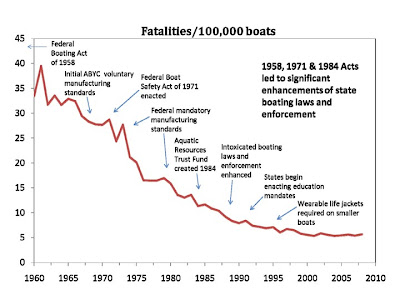
More than one hundred years ago, Congress enacted the Motorboat Act of 1910, establishing the first federal laws governing recreational boats. In 1971, when the number of registered boats reached 5.5 million and the number of recreational boating deaths reached 1,582 in a single year, Congress enacted the Federal Boat Safety Act, the most comprehensive legislation ever enacted to enhance boating safety.
In addition to formally establishing the National Recreational Boating Safety Program, a key component of this act gave the Coast Guard the authority to establish mandatory boat manufacturing and other standards, which have reduced boating accidents, property damage, injuries, and deaths.
By the year 2000, there were
nearly 12.8 million registered boats in the U.S., and the annual number of deaths dropped to approximately 700, bringing the ratio of deaths compared to the number of registered boats to a record low.
Are We There Yet?
For the Coast Guard and its many partners, though, even one death is unacceptable. In the spring of 2007, 20 organizations signed the Strategic Plan of the National Recreational Boating Safety Program, whose strategies include:
- improving accident reporting through regulatory and policy amendments,
- enhancing training for investigators,
- creating better measures to determine the effectiveness of the strategies,
- focusing on measures that will increase life jacket wear (given that most boating deaths are drownings),
- enhancing the education and skill levels of boat operators.
For more information:
Full article is available at http://www.uscg.mil/proceedings/fall2010.
Subscribe online at http://www.uscg.mil/proceedings/subscribe.asp.
Subscribe to:
Posts (Atom)
Subscribe To


 Posts
All Comments
Posts
All Comments