
This "Chemical of the Quarter" excerpt is from the U.S. Coast Guard “Proceedings of the Marine Safety & Security Council” magazine, by LCDR Gretchen Bailey, Marine Inspector, U.S. Coast Guard Hazardous Materials Standards Division
What is it?
Acrylonitrile is a colorless to pale yellow volatile liquid that is soluble in water and used in common solvents. Technical-grade acrylonitrile is more than 99 percent pure and always contains a polymerization inhibitor.
Acrylonitrile is a reactive chemical that polymerizes (converts one compound into another) spontaneously, either when heated or in the presence of a strong alkali. I
How is it shipped?
Acrylonitrile is typically shipped as a liquid in low-pressure tank railcars, as liquid in tank barges, or by truck as liquid in non-pressure liquid tanks.
Why should I care?
Shipping concerns.
Acrylonitrile is a polymerizing cargo that can become explosive when heated or involved in a fire. This product has a very low flash point—30 degrees Fahrenheit—and using water to fight the fire may be inefficient. When this cargo is heated or burned, it may produce a toxic vapor of hydrogen cyanide gas, so it is essential to keep a safe distance during a fire. Additionally, its vapor is heavier than air and has been known to travel a considerable distance to an ignition source, then flash back to the spill.
Health concerns.
It is very toxic by ingestion, inhalation, or absorption through the skin. Symptoms of poisoning will begin with irritation of the eyes, limb weakness, difficulty in breathing, dizziness, and impaired judgment. If the degree of poisoning increases, the symptoms will progress to cyanosis, nausea, collapse and loss of consciousness, irregular breathing, convulsions, and respiratory arrest.
Because it is lighter than water, acrylonitrile will form a light surface sheen when spilled on the water. Sorbent booms, pillows, and other containment tools will be contaminated and must not be handled without appropriate personnel protective equipment. However, due to its moderately high solubility, acrylonitrile will quickly dissolve into the water column.
Fire or explosion concerns.
Acrylonitrile is flammable and has the capability to explode. This happens when the cargo is heated, causing a polymerization reaction, which is highly exothermic. If the cargo is involved with a fire, the fumes from the cargo are a poisonous gas and should be avoided.
It is essential for emergency responders to wear self-contained breathing apparatus and rubber overclothing (including gloves), and to combat the fire from a safe distance or protected location. The most efficient way to extinguish the fire is with dry chemical foam, alcohol foam, or carbon dioxide. With water, use spray or fog; do not use straight stream.
What is the Coast Guard doing about it?
Acrylonitrile is categorized as a “Subchapter D” cargo, regulated in 46 Code of Federal Regulations Part 30.25. This cargo is carried in tank barges and ships that are required to be inspected by the Coast Guard.
Required design and construction standards for these vessels include:
· being double-skinned,
· having spacing between the hull and the inner tank wall,
· employing individual tank manifolds and pumps to avoid cross-contamination,
· utilizing a separate tank venting facility,
· being capable of internally circulating the tanks,
· being capable of being ventilated.
For more information:
Full article is available at http://www.uscg.mil/proceedings/fall2010.
Subscribe online at http://www.uscg.mil/proceedings/subscribe.asp.

A discussion forum on Marine Safety, Recreational Boating Safety, and waterways managment as we work together to protect maritime commerce and mobility, the marine environment, and safety of life at sea.
Showing posts with label Boating Safety. Show all posts
Showing posts with label Boating Safety. Show all posts
Thursday, September 22, 2011
Wednesday, September 21, 2011
The Coast Guard Auxiliary: Helping yourself while helping others.

Excerpt from U.S. Coast Guard Proceedings of the Marine Safety & Security Council magazine by AUX Gary Nordlinger, The Coast Guard Auxiliary.
Each year the Coast Guard invests millions of dollars training auxiliarists in areas such as leadership, seamanship, public affairs, website design, instruction, and facilitation. Like active duty Coast Guard personnel, auxiliarists undergo background checks as part of their enrollment process to determine their suitability for service.
Auxiliarists are trained to Coast Guard standards and regularly serve alongside the active duty in various capacities and at venues ranging from cutters to command centers, medical facilities, and Coast Guard headquarters.
Accomplishments: In 2009, USCG Auxiliarists donated more than 4.5 million hours to public safety and support of the U.S. Coast Guard. Public outreach programs are among our most important activities, and span a wide range of missions, as noted below.
- Vessel safety checks: Auxiliarists conduct about 100,000 complimentary vessel safety checks each year on recreational craft to make sure safety equipment is in working order and sufficient in quantity and the vessel is seaworthy.
- Public education classes: Each year thousands of boaters complete auxiliary courses on boating skills, seamanship, navigation, sailing, and other related topics.
- Marine dealer visits: Auxiliarists make tens of thousands of visits each year to businesses selling boats and boating-related products to stock public displays of boating safety literature and publicize upcoming boating safety classes.
- Public affairs: In 2009 alone, auxiliarists devoted more than 180,000 hours staffing booths at boat shows, giving presentations to civic and educational organizations, and reaching out to the news media and boating public regarding boating safety and maritime security.
- Legislative outreach: Auxiliarists maintain close relationships with state legislatures, state boating administrators, and other public and non-profit organizations.
- Coast Guard recruiting: Hundreds of auxiliarists support Coast Guard active duty recruiting efforts and also visit high schools to encourage students to consider applying to the Coast Guard Academy.
Full article is available at http://www.uscg.mil/proceedings/fall2010.
Subscribe online at http://www.uscg.mil/proceedings/subscribe.asp.

Tuesday, September 20, 2011
Return on Investment: The value of the U.S. Coast Guard Auxiliary.
Excerpt from U.S. Coast Guard Proceedings of the Marine Safety & Security Council magazine by CDR David Chareonsuphiphat, Director, Northern Region Auxiliary
U.S. Coast Guard District Eleven Prevention Division.
The Coast Guard Auxiliary is made up of more than 30,000 volunteers who donate their time and effort as well as their boats, aircraft, and radio facilities to the U.S. Coast Guard. Over 4,000 vessels, 240 aircraft, and 2,600 radio facilities have been accepted for use annually to aid the Coast Guard in carrying out its many missions.
In an average year the Coast Guard Auxiliary:
- provides 4,500,000 volunteer hours to the U.S. Coast Guard,
- saves 800 lives,
- assists 13,000 people in distress,
- protects $92,000,000 in property,
- conducts 132,000 vessel safety checks,
- conducts 2,000 commercial fishing examinations,
- conducts over 86,000 marine dealer visits,
- provides 4,000 vessel facilities to the Coast Guard,
- provides 240 air facilities to the Coast Guard,
- conducts 16,600 public education sessions and teaches 2,800 boating safety courses.
What Do Auxiliarists Do? Auxiliarists perform a wide range of duties, including recreational boating safety, vessel safety, commercial fishing vessel examinations, private aids to navigation verifications, program dealer visits, and marine safety education.
So What Does the Coast Guard Get? The value of volunteer time is calculated annually by an organization called the “Independent Sector,” which is a leadership forum of charities, foundations, and corporate giving programs. The 2009 value of a volunteer hour: $20.25.
In 2009, the auxiliary provided more than 4.5 million volunteer hours to the Coast Guard, which comes to approximately $91 million dollars in labor, using that independent estimate. Put another way, the Coast Guard Auxiliary’s labor hours in 2009 are equivalent to 2,186 full-time Coast Guard employees.
Continuing the math and factoring in the value of property saved, the return on investment ranges from 970 percent to 1,200 percent for the years 2006 to 2009, or up to $12 for every dollar spent.
Full article is available at http://www.uscg.mil/proceedings/fall2010.
Subscribe online at http://www.uscg.mil/proceedings/subscribe.asp.
Wednesday, September 14, 2011
Personal Watercraft Industry’s Model Legislation
Excerpt from U.S. Coast Guard Proceedings of the Marine Safety & Security Council magazine by Ms. Maureen A. Healey
Executive Director, Personal Watercraft Industry Association
The personal watercraft (PWC) industry supports strong boating laws and their strict enforcement, as well as mandatory boater education for operators.
To do our part, the industry encourages state lawmakers to enact industry-backed model legislation that encourages all states to set a minimum age of 16 to operate a PWC (18 for rentals) and requires all personal watercraft operators, regardless of age and experience, to pass a boater education course.
In addition, the industry advocates for personal watercraft use only during daylight hours; laws against reckless operation; and rules regarding operation within 100 feet of shore, anchored boats, piers, or swimmers.
For more information visit http://www.uscg.mil/proceedings/fall2010.
Subscribe online at http://www.uscg.mil/proceedings/subscribe.asp.
Tuesday, August 30, 2011
Recreational Boating Safety Outreach.
Excerpt from U.S. Coast Guard Proceedings of the Marine Safety & Security Council magazine by Mr. Alston Colihan, Technical Writer
The Office of Auxiliary and Boating Safety administers a variety of educational outreach programs to help reduce the numbers of boating accidents, fatalities, injuries, and property damage involving recreational boats. Some examples include:
The Boat Factory Visit Program
Requires recreational boat manufacturers to self-certify compliance with U.S. Coast Guard safety standards.
The credibility of that certification process is maintained by:
visits to domestic boat manufacturing plants to educate boat builders,
the authority to assess penalties against boat builders who are willfully non-compliant.
This program requires the manufacturer or importer to certify that each of its boats complies with federal safety standards. The Coast Guard does not require specific procedures to determine compliance, so the manufacturer may employ a third-party certification service, use an independent laboratory, or use the company’s in-house technical staff.
National Marine Manufacturers Association Yacht Certification Program
Offers member manufacturers’ boat inspections by third-party inspectors to certify compliance with Coast Guard safety standards and voluntary American Boat and Yacht Council standards.
Educational Efforts: New boat manufacturers are provided with a “Boatbuilder’s Handbook” CD, which contains information regarding the laws, regulations, and safety standards applicable to builders of recreational boats; copies of compliance guidelines and explanations for test procedures for each of the safety standards; and a variety of references concerning boat manufacturing, compliance testing, and the recreational boating product assurance program.
Visit Schedule: The Recreational Boating Factory Visit Program employs “compliance associates,” most of whom were former inspectors in the Coast Guard commercial vessel safety program.
The visit schedule is as follows:
annual visits to manufacturers whose boats are subject to most of the standards;
biennial visits to manufacturers whose boats are subject to some of the standards;
manufacturers of other boats that are excepted from the standards, such as canoe and kayak manufacturers, are visited at least once every three years.
These visits ensure that manufacturers understand the safety standards, know how to comply with them, and can inspect any boats under construction for compliance. In addition, boat manufacturers are also made aware of voluntary safety standards such as those published by the American Boat and Yacht Council.
Product Assurance Enforcement: The Coast Guard is exploring better coordination between the boating safety program and local Officers in Charge, Marine Inspection in the enforcement of civil penalties for recreational boat manufacturer violations.
The Recreational Boating Safety Visitation Program
Formerly known as the Marine Dealer Visitor Program, the program’s goal is to build long-lasting relationships with the recreational boating safety community as a whole.
PICTURED: A compliance associate inspects a boat’s wiring harness.
Subscribe online at http://www.uscg.mil/proceedings/subscribe.asp.
Thursday, August 25, 2011
The Case for Mandatory Recreational Boating Education
Excerpt from U.S. Coast Guard Proceedings of the Marine Safety & Security Council magazine by Mr. Fred W. Poppe, Vice President, of National Boating Federation.
A recent Coast Guard study indicates that fewer boating fatalities occur in states that have implemented requirements for boat operators to be educated in a more rapid timeframe.
Thus, the course for future reduction in accidents, injuries, and fatalities is clear:
A recent Coast Guard study indicates that fewer boating fatalities occur in states that have implemented requirements for boat operators to be educated in a more rapid timeframe.
Thus, the course for future reduction in accidents, injuries, and fatalities is clear:
- Every state should enact mandatory boating education for all recreational vessel operators.
- The National Boating Federation, its member organizations, and their delegates continue to be involved in efforts to pass mandatory boating education laws in their states. In addition, members participate in and contribute to 42 national, regional, and international maritime organizations through the federation’s executive committee members and member delegates.
Subscribe online at http://www.uscg.mil/proceedings/subscribe.asp.
Thursday, August 18, 2011
U.S. Army Corps of Engineers Life Jacket Policy Test: More wear? More lives saved.
Excerpt from U.S. Coast Guard Proceedings of the Marine Safety & Security Council magazine by Ms. Lynda Nutt, U.S. Army Corps of Engineers, Manager, National Operations Center for Water Safety
Despite the national reductions in recreational boating-related casualties following the Federal Boating Safety Act of 1971, U.S. Army Corps of Engineers (USACE) recreation managers struggled to minimize serious injuries and fatalities occurring on their waters throughout the 1970s and 1980s.
By 1985, the corps was using aggressive water safety educational campaigns and key visitor assistance initiatives led by park rangers in local communities, parks, and on the water to warn the public of open water recreation risks and encourage safer behaviors. While all these efforts had a dramatic effect on reducing the numbers of fatalities, they still averaged 170 each year.
 In 2007, USACE Maj. Gen. Donald T. Riley tasked personnel to conduct a policy test to measure the effect of adopting a mandatory life jacket policy. In 2008, USACE moved out with its policy test in the Pittsburgh and Vicksburg Districts.
Vicksburg Findings Impressive
Vicksburg officials reported that the initial public reaction to the life jacket policy was mixed. However, rangers were able to gain significant compliance without having to issue one citation over the course of the recreational summer.
Pittsburgh Results Disappoint
Since 1990, Pittsburgh District policy mandated that life jackets be worn by all non-swimmers and occupants of vessels under 16 feet. Unfortunately by the end of the “test” recreation season, it had achieved only a 3.7 percent cumulative wear rate on the test lakes in this region, while nearby control lakes in Ohio showed wear rates of more than seven percent.
Clearly, the policy had become stale after nearly two decades with no new emphasis on promotion or enforcement. The policy was also limited in scope, applying only to craft less than 16 feet, while the majority of boats on these test lakes were greater in size. It was also noted that Ohio boating safety officials were engaged to a much greater degree in the National Safe Boating Council’s “Wear It!” campaign to encourage voluntary life jacket wear.

Despite the national reductions in recreational boating-related casualties following the Federal Boating Safety Act of 1971, U.S. Army Corps of Engineers (USACE) recreation managers struggled to minimize serious injuries and fatalities occurring on their waters throughout the 1970s and 1980s.
By 1985, the corps was using aggressive water safety educational campaigns and key visitor assistance initiatives led by park rangers in local communities, parks, and on the water to warn the public of open water recreation risks and encourage safer behaviors. While all these efforts had a dramatic effect on reducing the numbers of fatalities, they still averaged 170 each year.
In 2007, USACE Maj. Gen. Donald T. Riley tasked personnel to conduct a policy test to measure the effect of adopting a mandatory life jacket policy. In 2008, USACE moved out with its policy test in the Pittsburgh and Vicksburg Districts.Vicksburg Findings Impressive
Vicksburg officials reported that the initial public reaction to the life jacket policy was mixed. However, rangers were able to gain significant compliance without having to issue one citation over the course of the recreational summer.
Observation data supported that a cumulative wear rate of nearly 71 percent on the Vicksburg test waters. Comparatively, nearby “control” lakes, where policy wasn’t introduced, were still showing only six percent wear rates.
Pittsburgh Results Disappoint
Since 1990, Pittsburgh District policy mandated that life jackets be worn by all non-swimmers and occupants of vessels under 16 feet. Unfortunately by the end of the “test” recreation season, it had achieved only a 3.7 percent cumulative wear rate on the test lakes in this region, while nearby control lakes in Ohio showed wear rates of more than seven percent.
Clearly, the policy had become stale after nearly two decades with no new emphasis on promotion or enforcement. The policy was also limited in scope, applying only to craft less than 16 feet, while the majority of boats on these test lakes were greater in size. It was also noted that Ohio boating safety officials were engaged to a much greater degree in the National Safe Boating Council’s “Wear It!” campaign to encourage voluntary life jacket wear.
Future Efforts
USACE officials have documented four lives saved on the Mississippi lakes specifically tied to the policies implemented during the first test season.
“These victims stated that they would not have worn a life jacket if it hadn’t been for the policy,” said Michael Ensch, chief of the USACE Operations Division. “In each case, the situations were challenging enough that survival without the life jacket was questionable.”
The USACE will continue the tests in the Pittsburgh and Vicksburg Districts and will evaluate data collection in monitoring wear rates. In addition, impact on staffing/budget requirements and capabilities, and public, stakeholder, and congressional reactions will also be monitored and evaluated. All findings will be forwarded to USACE leadership for action.
Full article is available at http://www.uscg.mil/proceedings/fall2010.
Subscribe online at http://www.uscg.mil/proceedings/subscribe.asp.
Wednesday, August 17, 2011
Safe Paddle Sports
Excerpt from U.S. Coast Guard Proceedings of the Marine Safety & Security Council magazine by Mr. Jeremy Oyen, Director of Safety Education, Instruction, and Outreach, American Canoe Association
The American Canoe Association offers online resources to paddlers of all abilities and levels, including:
The American Canoe Association offers online resources to paddlers of all abilities and levels, including:
- 11 safety brochures (four translated into Spanish),
- 4 safety pamphlets,
- 4 safety posters,
- 8 safety and stewardship videos.
Additional information and training is available for classroom and on-water education. The goal is to reduce the number of accidents and fatalities by emphasizing the need for education even for those who do not consider themselves “paddlers,” but might use a canoe, kayak, or raft to participate in other outdoor activities.
Full article is available at http://www.uscg.mil/proceedings/fall2010.
Subscribe online at http://www.uscg.mil/proceedings/subscribe.asp.
Friday, August 5, 2011
40th Anniversary of the Federal Boat Safety Act of 1971
Next Wednesday, August 10th, is the 40th anniversary of the enactment of the Federal Boat Safety Act. In 1971, there were 5,510,092 numbered (registered) boats and 1,582 boating deaths. In 2010, there were 12,438,926 registered boats and 672 boating deaths. These results are directly tied to the successes of the Federal Boat Safety Act of 1971.

Wednesday, August 3, 2011
The Non-profit Organization Grant Program
Partnering to improve boating safety—Part 2.
Excerpt from U.S. Coast Guard Proceedings of the Marine Safety & Security Council magazine
Recent Successful Applications
2005
Navigation Lighting on Barges. National Water Safety Congress. The towboat/tugboat/barge industry expressed an interest in determining a manner to light their barges while under tow.
2006
Boating and Water Safety Summit. National Safe Boating Council/National Water Safety Congress. A multi-year initiative to conduct conferences to impact the safer use of water resources through improved public education and more efficient means of transferring information among waterways managers, user groups, and individuals.
Development of Risk-Based Assessments. Underwriters Laboratories. Developing a risk-based compliance approval methodology for life jackets.
National Estimates of Personal Flotation Device Wear Rates. JSI Research. A multi-year effort to measure the effectiveness of initiatives to increase life jacket wear.
Staged Collisions. National Association of State Boating Law Administrators (NASBLA). Staged boating collisions for boating safety accident investigation training.
2007
BUI Detection and Enforcement Training Seminars. NASBLA. Primary objectives: Review and distribute an updated BUI curriculum package for marine officers and produce regional BUI officer training seminars.
Cold Water Boot Camp USA. National Water Safety Congress. Goal: Reduce fatalities by targeting immersion in cold water as a specific issue.
“Paddle Safe, Paddle Smart.” American Canoe Association. Moving “Paddle Safe, Paddle Smart” lessons from an extra-curricular option into the regular classroom.
2008
Inflatable Life Jacket Testing for Children 16 Years and Under. Foundation for Recreational Boating Safety and Educational Awareness. Goal: Determine if and under what circumstances children and adult non-swimmers using automatic inflatable life jackets reduce their risk of drowning.
Personal Flotation Device (PFD) Point of Purchase Show Board. United Safe Boating Institute. Show board depicting PFDs for sailing, paddling, skiing, operating personal watercraft, fishing, hunting, and general recreational boating distributed to retail outlets, parks, ranger stations, safe boating booths, and boating safety facilities.
PSA on Dangers of Carbon Monoxide on Boats. Carbon Monoxide Action Group. A nationally televised Public Service Announcement exposing the dangers of carbon monoxide on boats.
“WEAR IT!” National Safe Boating Council. This ongoing campaign encourages life jacket wear.
Full article is available at http://www.uscg.mil/proceedings/fall2010.
Subscribe online at http://www.uscg.mil/proceedings/subscribe.asp.
The Non-profit Organization Grant Program
Partnering to improve boating safety—Part 1.
Excerpt from U.S. Coast Guard Proceedings of the Marine Safety & Security Council magazine by Mr. Donald J. Kerlin, Chief, Program Management Branch and Ms. Linda Gray-Broughton, former Non-profit Organization Grant Coordinator, U.S. Coast Guard Boating Safety Division
The Federal Boat Safety Act of 1971 established the Recreational Boating Safety Federal Financial Assistance Program to permit states to assume a larger share of boating safety education, assistance, and enforcement activities. Of the funds appropriated for these programs, the Coast Guard is authorized to retain up to five percent for grants to national non-profit public service organizations.
The Process
The grant process begins with an announcement through the website http://www.grants.gov/, which includes a listing of suggested topic areas that receive additional points in the scoring process. About $6,000,000 is available for non-profit organizations each year.
Subject matter experts review each application using a “merit review” checklist, which focuses on technical merit, personnel qualifications, and the degree to which a proposal offers potential value and measurements to program goals.
Those applications meeting review standards (60 to 80 per year) are forwarded to the non-profit organization grant review team, which ranks selections based on parameters including:
Full article is available at http://www.uscg.mil/proceedings/fall2010.
Subscribe online at http://www.uscg.mil/proceedings/subscribe.asp.
Excerpt from U.S. Coast Guard Proceedings of the Marine Safety & Security Council magazine by Mr. Donald J. Kerlin, Chief, Program Management Branch and Ms. Linda Gray-Broughton, former Non-profit Organization Grant Coordinator, U.S. Coast Guard Boating Safety Division
The Federal Boat Safety Act of 1971 established the Recreational Boating Safety Federal Financial Assistance Program to permit states to assume a larger share of boating safety education, assistance, and enforcement activities. Of the funds appropriated for these programs, the Coast Guard is authorized to retain up to five percent for grants to national non-profit public service organizations.
The Process
The grant process begins with an announcement through the website http://www.grants.gov/, which includes a listing of suggested topic areas that receive additional points in the scoring process. About $6,000,000 is available for non-profit organizations each year.
Subject matter experts review each application using a “merit review” checklist, which focuses on technical merit, personnel qualifications, and the degree to which a proposal offers potential value and measurements to program goals.
Those applications meeting review standards (60 to 80 per year) are forwarded to the non-profit organization grant review team, which ranks selections based on parameters including:
- support of National Recreational Boating Safety Program goals,
- probability of project success,
- return on investment.
Full article is available at http://www.uscg.mil/proceedings/fall2010.
Subscribe online at http://www.uscg.mil/proceedings/subscribe.asp.
Thursday, July 14, 2011
The USCG Marine Patrol Officer Course
Excerpt from U.S. Coast Guard Proceedings of the Marine Safety & Security Council magazine by Mr. Mike Baron, Recreational Boating Safety Specialist, U.S. Coast Guard Boating Safety Division Program Operations Branch
To meet the requirements of the Federal Boating Safety Act of 1971, the Coast Guard established the National Boating Safety School. Although the course was originally focused on federal requirements and basic boating safety law enforcement techniques, over the years legislation was enacted that required states to take the primary role in their own recreational boating programs.
In support of these new requirements, the Coast Guard launched the National Safe Boating Instructor Course in 1983 with a curriculum focused on training law enforcement officers to conduct boating safety classes for the public while also training fellow marine patrol officers as instructors.
In 2000 the curriculum was updated to include practical field knowledge, training methodologies, and skills, and the course name was changed to the Marine Patrol Officer Course.
Curriculum
The course is two weeks long and is conducted four times each year.
During the first week, students alternate between training methodologies and skills development to develop a training session based on the federal carriage requirements for recreational boating safety. The officers present their training session at the end of the week to the other officers in class and the MPOC staff.
The second week is devoted to field skills. Coast Guard Law Enforcement Academy staff conduct training on boating under the influence regulations and detection, firearms laws, navigation rules scenarios, and water survival techniques. National Association of State Boating Law Administrator instructors conduct training on boating accident response and the reporting process. An instructor and certified marine investigator from the International Association of Marine Investigators conduct classroom training on stolen boat identification, followed by a practical field exercise.
Attendees also practice tactical procedures in “shoot houses.” These scenarios are performed in a mock-up building that resembles a ship as well as aboard a former break bulk freighter-turned-training-platform that is part of the FLETC’s training resource inventory.
Who Attends MPOC
The Marine Patrol Officer Course is open to all federal, state, and local marine patrol officers. As the course curriculum is not designed for senior boating safety officers, the preferred candidate possesses less than seven years of experience in boating safety. The ideal candidate demonstrates good potential to train fellow law enforcement officers or to teach boating safety to the public.
The student’s agency or department is responsible for transportation to and from Charleston, S.C. The Coast Guard provides all training materials, lodging, and meals. To date nearly 3,000 marine patrol officers have graduated.
For more information:
Full article is available at http://www.uscg.mil/proceedings/fall2010.
Subscribe online at http://www.uscg.mil/proceedings/subscribe.asp.
Thursday, July 7, 2011
The United Safe Boating Institute
Excerpt from U.S. Coast Guard Proceedings of the Marine Safety & Security Council magazine by Captain William Griswold, USCG (Ret.), President, United Safe Boating Institute
The United Safe Boating Institute (USBI) is an alliance of non-profit organizations united to provide a public service through preparation and distribution of focused boating educational information, funded by grants and/or public, private, and corporate contributions.
It was formed in the late 1980s by members of the Coast Guard Auxiliary, U.S. Power Squadrons, the American Red Cross, the U.S. Sailing Association, and the Canadian Power Squadrons. The American Canoe Association also joined the group a few years ago.
Targeted Initiatives
Safety Tips for Anglers, Hunters, and Campers is our most popular pamphlet. This 16-page publication outlines boating safety, first aid, aids to navigation, and navigation rules, with illustrations covering life jacket use, the dangers of alcohol and hypothermia, and equipment you should have on board.
Which Life Jacket for You? is a poster that displays pictures and brief descriptions of popular life jackets appropriate for use in various boating activities.
Five Tons and No Brakes is a short booklet aimed at houseboat operators. Normally, houseboat renters are not experienced boaters, and this sheet serves to acquaint them with issues they might encounter.
For more information:
Website: http://www.usbi.org/.
Full article is available at http://www.uscg.mil/proceedings/fall2010.
Wednesday, June 29, 2011
The National Recreational Boating Survey
Excerpt from U.S. Coast Guard Proceedings of the Marine Safety & Security Council magazine by Dr. Philippe Gwet, Mathematical Statistician, U.S. Coast Guard Office of Auxiliary and Boating Safety and Dr. Glenn Haas Professor, Colorado State University, Vice President
The National Recreational Boating Survey has undergone a major redesign to collect extensive information about the U.S. boating population, recreational vessels, and boating activities. Survey data will support strategies to reduce accidents and casualties and will be used to plan for future demand and participation.
The redesigned survey includes questions to help determine what motivates boaters to boat safely, what boating safety campaigns influence them and by what delivery system, and why individuals completed a boating safety instruction course.
The Coast Guard will implement the next two surveys in 2011 and 2013 to measure:
- exposure
- boat and boater hours on the water
- boat hours in docked recreation
- boating participation and boat ownership
- total annual participation overall
- total annual participation by boat type
- total boat ownership
- boating safety awareness and behaviors
- life jacket use
- reasons for life jacket use
- alcohol use and boat operation
- economic impact of recreational boating
- money spent on boats
- money spent in communities on boat trips
- negative event incidence and risk
- actual and reported accidents that cause injury and boat damage
- boat statistics
- features of boats such as hull material and propulsion systems
Three Survey Types
This data will be collected through three survey instruments—the boat survey, trip survey, and participant survey.
The boat survey collects information about the number and type of boats as well as information about how much money boat owners spend on their boats.
The trip survey will proceed monthly during the survey year. The sample will be boats that have responded to the boat survey and will sample individual trips and collect information about what happened on those trips: how long they lasted, what safety events occurred, and what money was spent.
The participant survey collects information about who spent time boating during the year.
For more information:
Full article is available at http://www.uscg.mil/proceedings/fall2010.
Subscribe online at http://www.uscg.mil/proceedings/subscribe.asp.
Tuesday, June 28, 2011
History of Boating Surveys
Excerpt from U.S. Coast Guard Proceedings of the Marine Safety & Security Council magazine
1960s
The Coast Guard began an informal survey process in the late ‘60s as an aid in allocating its boating safety resources. This initiative used a compilation of statistical data from various sources, including a statistical telephone survey of households in the Coast Guard’s Fifth District and an observational study of boating activities in the Chesapeake Bay.
This study revealed that 20 percent of the estimated 539,077 boat operators in the USCG Fifth District completed at least one formal boating safety course, and totaled about 76,473,600 exposure hours.
1970s
The second USCG-sponsored boating survey in 1974 collected data for the 1973 boating season. This was a national statistical survey designed with state-of-the-art methods, though based on a very small sample size—just 24,137 households.
While the household sample was too small to produce state-level boating statistics or national statistics by boat type, this survey introduced the concepts of “boat hours,” “passenger hours,” and “ratio of passenger hours per boat hour.” The statistics: boat hours were estimated at 1,549,137,000 hours; passenger hours 4,604,336,000.
The USCG conducted another national recreational boating survey in 1977 to collect 1976 boating season data. Although again small in scale (only 5,507 households), this was a well-designed statistical survey that produced broad national-level statistics on boat owners, operators, and boating activities among boating households.
Both the 1973 and 1976 surveys were weighted to yield continental U.S. estimates. For example, the 1976 survey estimated 11,322,000 recreational boats in the country with 2,255,624,000 boat hours and 7,635,246,000 passenger hours.
1980s-2002
In 1989, the USCG issued a grant to the American Red Cross to conduct a national recreational boating survey covering the period from October 1, 1988 through September 30, 1989. This survey was based on a sample of 3,700 recreational boating participants and estimated 4,922,143,730 passenger hours per year on owned, rented, or borrowed boats during 1989 (106.78 hours per boater).
The next USCG-sponsored survey produced only national-level boating statistics. The survey came in 1998 when a Coast Guard contractor conducted another national recreational boating survey based on a sample of 9,746 recreational boating participants.
In 2002 the USCG conducted a national recreational boating survey with the goal of producing state-level statistics. This survey was based on a substantial sample of 25,000 boat operators. However, its focus on only boat operators made the use of these statistics limited.
Stay tuned to learn about the redesigned USCG survey.
For more information:
Full article is available at http://www.uscg.mil/proceedings/fall2010.
Subscribe online at http://www.uscg.mil/proceedings/subscribe.asp.
Wednesday, June 22, 2011
Recreational Boating Accident Statistics and Trends
Excerpt from U.S. Coast Guard Proceedings of the Marine Safety & Security Council magazine by Ms. Susan Tomczuk, U.S. Coast Guard Office of Auxiliary and Boating Safety and Dr. L. Daniel Maxim, U.S. Coast Guard Auxiliary
Fatality rates for recreational boating accidents have historically been expressed as fatalities per 100,000 registered boats. In 2008, the total number of recreational boating fatalities in the United States was 709, a fatality rate of 5.6 deaths per 100,000 registered boats. This fatality rate has declined over the years—more than 83 percent since these statistics were first analyzed.
 This is gratifying, but from 1990 on, the average annual decrease in fatality rate was only 2.5 percent per year (denoted by the dashed red line in the chart), and annual fatalities appear to be “stuck” at around 700.

Fatality rates for recreational boating accidents have historically been expressed as fatalities per 100,000 registered boats. In 2008, the total number of recreational boating fatalities in the United States was 709, a fatality rate of 5.6 deaths per 100,000 registered boats. This fatality rate has declined over the years—more than 83 percent since these statistics were first analyzed.
This is gratifying, but from 1990 on, the average annual decrease in fatality rate was only 2.5 percent per year (denoted by the dashed red line in the chart), and annual fatalities appear to be “stuck” at around 700.Most Boating Fatalities Are Drownings
Drowning accounts for the majority of fatalities, particularly on smaller boats. Personal watercraft accidents are more likely to result in blunt trauma injuries (mostly due to speed). PWCs have fewer drownings since most states require operators and passengers to wear life jackets.
Drowning accounts for the majority of fatalities, particularly on smaller boats. Personal watercraft accidents are more likely to result in blunt trauma injuries (mostly due to speed). PWCs have fewer drownings since most states require operators and passengers to wear life jackets.
Life Jackets Save Lives
Most boating drownings are sudden, unexpected events, typically resulting from capsizing or falls overboard, which provide little time to don a life jacket.
Most boating drownings are sudden, unexpected events, typically resulting from capsizing or falls overboard, which provide little time to don a life jacket.
Life jacket wear rates are high for some boaters (typically skiers, personal watercraft occupants, and children), largely because they are legally required. But according to Coast Guard-sponsored life jacket wear rate observation studies, life jacket wear rates are not high for other boaters.
Alcohol Kills
One particularly telling boating accident report data field is the “primary contributing factor” for each reported accident. Each is plotted in the chart as a point showing the number of fatalities and number of accidents. For alcohol/drugs those numbers are 126 and 281.
One particularly telling boating accident report data field is the “primary contributing factor” for each reported accident. Each is plotted in the chart as a point showing the number of fatalities and number of accidents. For alcohol/drugs those numbers are 126 and 281.
Only factors resulting in at least 200 accidents or 25 fatalities are shown, the dashed lines show contours of constant ratios of fatalities per accident. The next figure illustrates contributing factors for casualties.

Alcohol/drugs remain important, but other factors increase in relative importance, such as inattention, proper lookout, speed, careless or reckless behavior, and passenger/skier behavior.
For more information:
Full article is available http://www.uscg.mil/proceedings/fall2010.
Online annual statistics reports are available at
http://www.uscgboating.org/statistics/accident_statistics.aspx.
Subscribe online at http://www.uscg.mil/proceedings/subscribe.asp.
Full article is available http://www.uscg.mil/proceedings/fall2010.
Online annual statistics reports are available at
http://www.uscgboating.org/statistics/accident_statistics.aspx.
Subscribe online at http://www.uscg.mil/proceedings/subscribe.asp.
Tuesday, June 21, 2011
Strategic Planning: Plotting a course for change.
Excerpt from U.S. Coast Guard Proceedings of the Marine Safety & Security Council magazine by Mr. James P. Muldoon, Chairman, National Boating Safety Advisory Council. Mr. Fred F. Messmann, Deputy Director, National Safe Boating Council
Recreational boating is a fun and generally safe activity, but every year hundreds die in accidents and thousands more are injured. Considering that approximately 77 million Americans participate in recreational boating, these numbers are statistically low. However, these deaths and injuries are preventable.
The most frequent causes of recreational boating accidents are:
Wear It
The focus: Increasing life jacket wear rates, interventions for boating under the influence, ensuring manufacturer compliance with federal regulations, and increasing frequency and accuracy in reporting of boating accidents.
National Recreational Boating Survey
Additionally, the USCG Boating Safety Division is working with boating safety experts to develop the National Recreational Boating Survey, which will provide scientific information about boaters’ behavior to compare to fatality and injury data to identify the greatest risks. The survey will be administered every two years.
The strategic plan will be reviewed every five years to:
Full article is available at http://www.uscg.mil/proceedings/fall2010.
Subscribe online at http://www.uscg.mil/proceedings/subscribe.asp.
Recreational boating is a fun and generally safe activity, but every year hundreds die in accidents and thousands more are injured. Considering that approximately 77 million Americans participate in recreational boating, these numbers are statistically low. However, these deaths and injuries are preventable.
The most frequent causes of recreational boating accidents are:
- Drowning. Causes: lack of boating safety knowledge, lack of life jackets, life jackets not worn, inability to swim, operating in heavy weather, alcohol or drug abuse.
- Falls Overboard. Causes: overloading, lack of safety knowledge, operator inattention, boat design, weather, alcohol or drug abuse.
- Collision with Vessel/Collision with Fixed Object (allision). Causes: lack of boating safety knowledge, operator inattention, no proper lookout, disregard of navigation rules.
Wear It
The focus: Increasing life jacket wear rates, interventions for boating under the influence, ensuring manufacturer compliance with federal regulations, and increasing frequency and accuracy in reporting of boating accidents.
National Recreational Boating Survey
Additionally, the USCG Boating Safety Division is working with boating safety experts to develop the National Recreational Boating Survey, which will provide scientific information about boaters’ behavior to compare to fatality and injury data to identify the greatest risks. The survey will be administered every two years.
The strategic plan will be reviewed every five years to:
- Determine progress.
- Analyze measurements.
- Consider new strategies.
Full article is available at http://www.uscg.mil/proceedings/fall2010.
Subscribe online at http://www.uscg.mil/proceedings/subscribe.asp.
Wednesday, June 15, 2011
A Century of Recreational Boating Safety—Part 1
Excerpt from U.S. Coast Guard Proceedings of the Marine Safety & Security Council magazine by CAPT Mark D. Rizzo, Chief, U.S. Coast Guard Office of Auxiliary and Boating Safety and Mr. Jeff Hoedt, Chief, Boating Safety Division U.S. Coast Guard Office of Auxiliary and Boating Safety.
More than one hundred years ago, Congress enacted the Motorboat Act of 1910, establishing the first federal laws governing recreational boats. In 1971, when the number of registered boats reached 5.5 million and the number of recreational boating deaths reached 1,582 in a single year, Congress enacted the Federal Boat Safety Act, the most comprehensive legislation ever enacted to enhance boating safety.
In addition to formally establishing the National Recreational Boating Safety Program, a key component of this act gave the Coast Guard the authority to establish mandatory boat manufacturing and other standards, which have reduced boating accidents, property damage, injuries, and deaths.
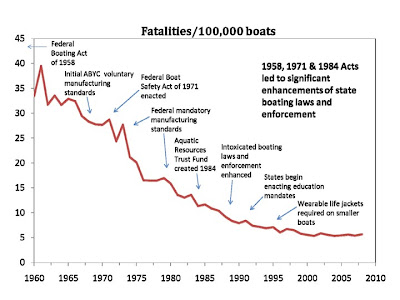
More than one hundred years ago, Congress enacted the Motorboat Act of 1910, establishing the first federal laws governing recreational boats. In 1971, when the number of registered boats reached 5.5 million and the number of recreational boating deaths reached 1,582 in a single year, Congress enacted the Federal Boat Safety Act, the most comprehensive legislation ever enacted to enhance boating safety.
In addition to formally establishing the National Recreational Boating Safety Program, a key component of this act gave the Coast Guard the authority to establish mandatory boat manufacturing and other standards, which have reduced boating accidents, property damage, injuries, and deaths.
By the year 2000, there were
nearly 12.8 million registered boats in the U.S., and the annual number of deaths dropped to approximately 700, bringing the ratio of deaths compared to the number of registered boats to a record low.
Are We There Yet?
For the Coast Guard and its many partners, though, even one death is unacceptable. In the spring of 2007, 20 organizations signed the Strategic Plan of the National Recreational Boating Safety Program, whose strategies include:
- improving accident reporting through regulatory and policy amendments,
- enhancing training for investigators,
- creating better measures to determine the effectiveness of the strategies,
- focusing on measures that will increase life jacket wear (given that most boating deaths are drownings),
- enhancing the education and skill levels of boat operators.
For more information:
Full article is available at http://www.uscg.mil/proceedings/fall2010.
Subscribe online at http://www.uscg.mil/proceedings/subscribe.asp.
Thursday, June 9, 2011
Introduction to Recreational Boating Safety—Assistant Commandant’s Perspective
Excerpt from U.S. Coast Guard Proceedings of the Marine Safety & Security Council magazine by RADM Paul Zukunft, U.S. Coast Guard Assistant Commandant for Marine Safety, Security and Stewardship
The Coast Guard has a long history of working with the recreational boating community, and the results of our collective safety efforts have been impressive. In the last 40 years the number of boating participants has grown exponentially, yet the number of boating incidents and deaths continue to decrease.
This success is attributable to the cooperative partnerships that have been forged among federal, state, and local governments; the boating industry; boating safety organizations; and recreational boaters.
Yet there is more that needs to be done. While we’ve brought the number of deaths down significantly, there are still more than 700 recreational boating fatalities each year. We can—and will—do better.
If you are an active partner in the National Recreational Boating Safety Program, I sincerely thank you for your commitment. Please continue to work with us to improve this program. If you are not an active partner, please consider coming aboard. Together we are making a difference that has a positive impact on tens of millions of Americans every year.
For more information:
Full article is available at http://www.uscg.mil/proceedings/fall2010.
Subscribe online at http://www.uscg.mil/proceedings/subscribe.asp.
Wednesday, November 10, 2010
Proceedings Fall 2010 Available Online
 The current edition of Proceedings (Fall 2010 – Recreational Boating Safety) is available online at http://www.uscg.mil/proceedings/.
This “Recreational Boating Safety” issue highlights the myriad ways in which the National Recreational Boating Safety Program serves to improve marine safety.
Additionally, it gives appropriate credit to the Coast Guard's many recreational boating safety partners and contains ample information about their efforts.
Subscribe to:
Posts (Atom)
Subscribe To


 Posts
All Comments